
2O25 Was An Operaaa
On new limits of experience, and the reemergence of old forms

I saw Andrea Chénier at the Met when my in laws were in town for Thanksgiving. The only other opera I’d seen before was Carmen when I was fourteen, at which I fell asleep. This was before the Met installed those awesome subtitles at the dashboard of each chair.
This time around I was wide awake. I loved the full orchestra! I loved the singers! I was not bothered by the paint-by-numbers story— it felt nice to engage in an art so archaic that good characterization was the least important thing about it. What impressed me most about the production was its scale. The full orchestra, the depth of the stage, the sheer amount of performers! How pleasantly strange it all was.
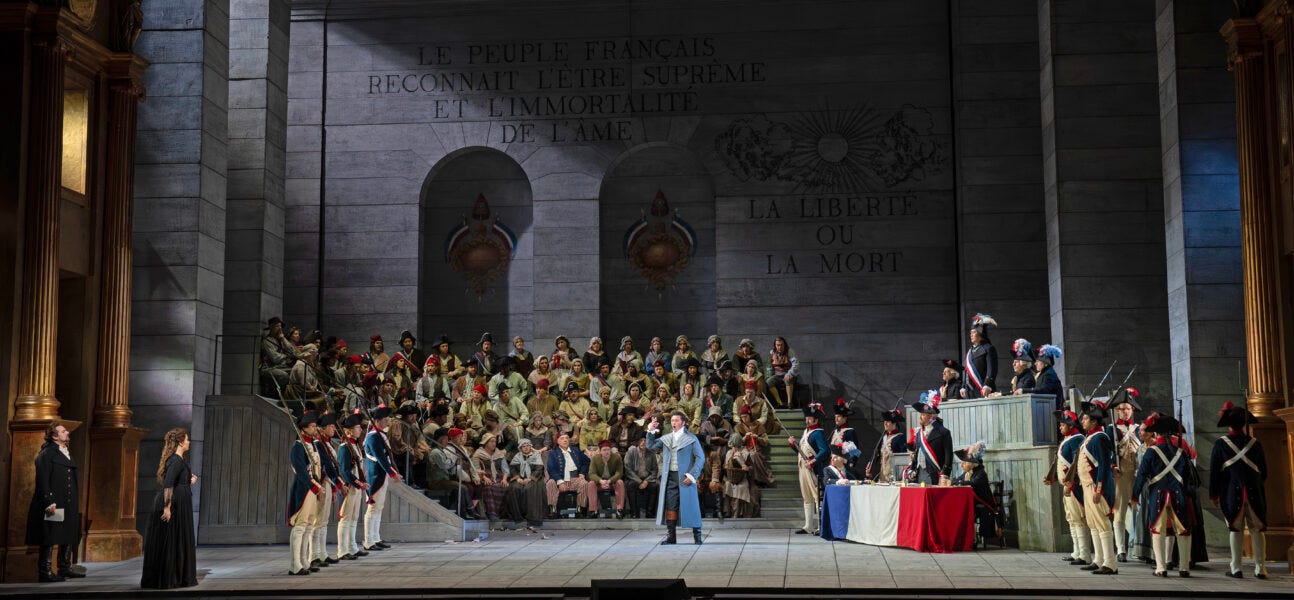
Look how many people fit on this stage
This year, it feels like the never-ending me-me-me narratives of personal experience took a backseat to older, bigger forms. I felt this most clearly on a 101 degree day in June, the day Zohran won the primary.
I had recently started a revision of my story collection that ultimately took me half the year to finish. After an uncomfortably humid, delirious morning of writing I decided to meet Dusty and Yip at Film Forum, where I saw Apocalypse Now for the first time. I sat down happily in my sundress in the dark theater, never once feeling cold.
The first big scene in that movie is, you know, a napalm attack on a village in Vietnam set to “Ride of the Valkyries.” It repulsed me, but I had nowhere to go, so I found myself submitting to the rules of the war and the jungle. By the time Martin Sheen’s Captain Willard gets to Marlon Brando’s Kurtz, having lost the majority of his men, I, too had abandoned all hope. I’m one of probably four people on earth who read Notes on Apocalypse Now before seeing the film (wrote about it here in my 2022 reading roundup) so I went in with some backstory. To see the product of a truly great artist going to the ends of the earth, endangering himself and everyone around him, to make real what he sees in his head… to face his shadows… it was hitting for me, what can I say. It was demonically hot out, and Kurtz was suddenly Goals. I left the theater feeling haunted!
Afterwards we got Uzbeki food in our neighborhood, which is when I saw on my phone that they called it for Zohran. It felt so opposite of what I had been gearing myself up to do for the summer— embrace the shadows of my own psyche— and the world’s— as I figured out how to revise the book to feel more true. And yet, here was real hope for humanity prevailing suddenly, despite all the despair.
They called it for Zohran officially in November, a few minutes after Dusty, Amy, Cat, Brian, and I got out of Ragtime at Lincoln Center (I was so underemployed but so out and about this year :D). Ragtime is based on E.L. Doctorow’s classic novel, and this is its first and only revival since its two year Broadway run in 1998. The show felt very 1998, a throwback to a more prosperous time, this lush, expansive production with a massive ensemble and a full orchestra. OPERATIC, if you will. Much like Andrea Chénier, Ragtime is not an uplifting show. It’s about the very devastating limits of the American Dream as America grows via industrialization and immigration.
But once again… hope! Zohran won not because history repeats itself, but because enough people agreed that things needed to change.
RIP YOLO (2011-2025).
Experientialism, Mark Greif explains in his Obama-era book Against Everything (N+1, 2016), is when lived experience substitutes for politics or structure. This has been the wave of culture for a while, maybe since Drake declared “You only live once, that’s the motto, n****, YOLO” in 2011.
It’s not surprising to me that Ragtime, a story about America reorganizing itself at its new scale, was staged again this year, or that Film Forum ran Apocalypse Now, a film about the machine of war, for a month straight. With politics, economics, reality getting so weird— with so much feeling newly at stake —it makes sense that everything “old” is new again.
It feels like in 2025 culture finally moved toward bigger, older forms that are less concerned with individual psychology, identity, and experience. I don’t think this is necessarily for better or for worse, but it’s certainly what’s happening now.
Many old orders, like the return of Nazi-ism, are dangerous. Some, like healthy lifestyle obsessions or looksmaxxing, are slightly sinister but mostly harmless. Others, like mending one’s clothes, listening to classical music, or the return of criticism and the shunning of poptimism, I’d say are largely good.
At this slop-led moment in time, I’d be hard pressed to meet anyone on the left who thinks there’s absolutely nothing to learn from the forms and structures of the past.
When I look back at the books I read this year, I find I most enjoyed Capital-N Novels like Bonfire of the Vanities and American Pastoral and Sister Carrie, ones where characters’ psychology is not innate, but a consequence of context— their class, religion, how much power they have. Their relationship with THE AMERICAN DREAM. A more experimental, non-American novel that I enjoyed this year— Zoo, or Letters Not About Love by Viktor Shklovsky— was so dependent on context that the edition I read prefaced each chapter with a different explanation of the sociopolitics of the Russian expat community in 1950s Berlin.
Similarly, the films I most enjoyed— One Battle After Another, Atropia, an Italian film I saw at NYFF called The Last One for the Road— are just as concerned about their protagonists as they are about the material reality of their lives: the landscapes they inhabit, the roles they imagine for themselves inside historical or social systems, their strained relationships with the powers that be.
Video for “BAILE INoLVIDABLE,” my personal fave off DTMF…
Bad Bunny’s DeBÍ TIRAR MáS FOTOS was my favorite album from early winter— a deliberate homage to the Uncs and the Tías, to old school Puerto Rican plena, an album of new-but-old sounds that sampled familiar classics. It reminded me of what Beyoncé did with Renaissance in 2022— instead of treating house and Black queer club music with a nostalgia filter, she used it as raw material to create something new and rigorous that feels current still, three years later.
In that sense, Rosalía’s LUX has felt less like my fave album of the year, and more like some mystical labyrinthian world I entered on November 7th and have yet to leave.
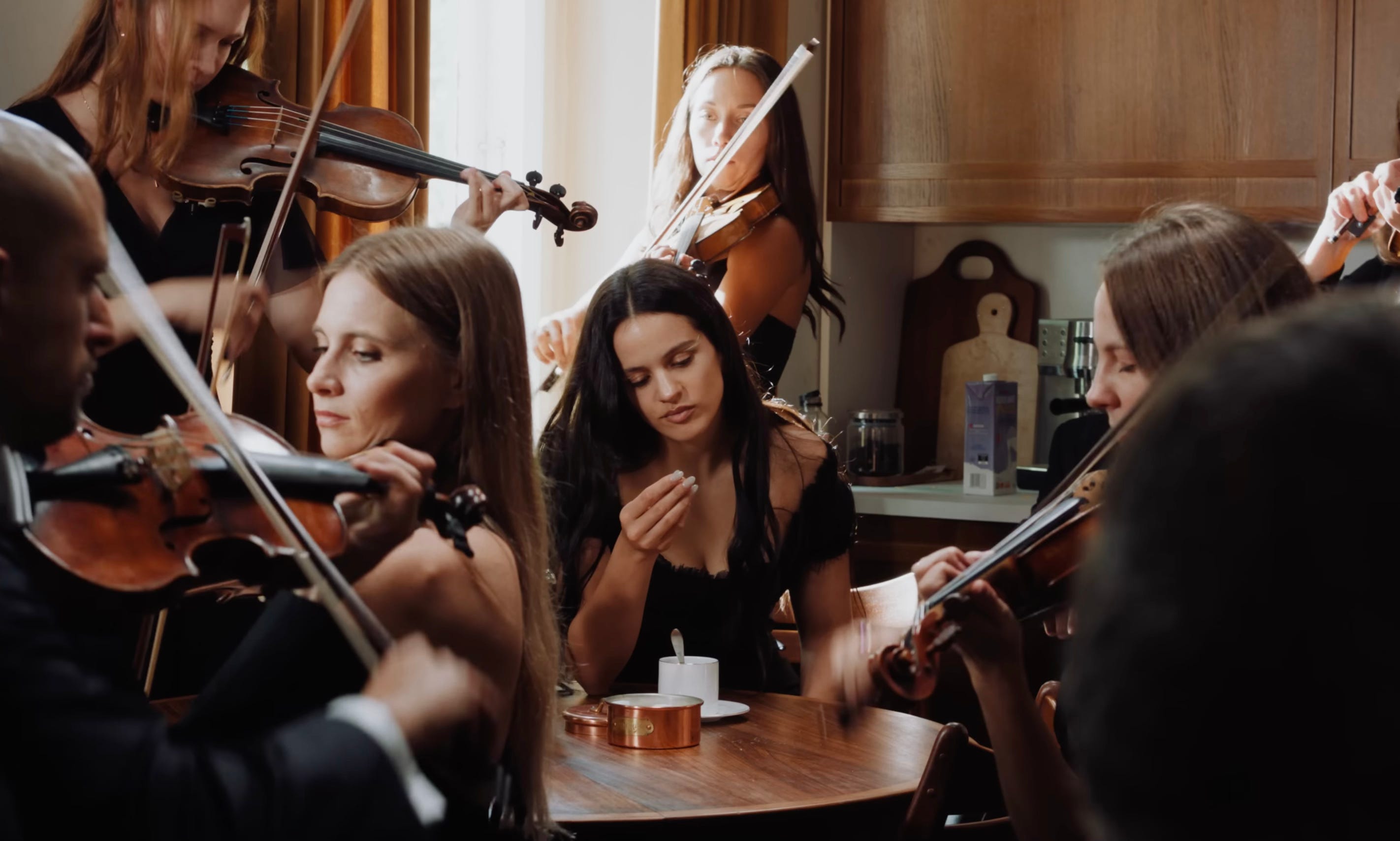
A still from the “Berghain” video
I started drafting this essay on the flight back from a tender Christmas in Montana, where I oscillated between the unplaceable anxiety that too much family time can trigger and a deep sense of gratitude that I get to spend holidays with my beloved family at all. When the plane finally took off amidst holiday delays and my lil’ 5:1 CBD:THC edible started to hit, I started LUX from the top for the umpteenth time, and landed on what I’ve decided is the soundbite of 2025 (to moi).
I’ve been hypnotized by “Relíquia,” Track 2 of LUX, since I first heard it. In the first three and a half minutes of the song Rosalía sings about things she’s lost, and the cities in which she’s lost them (her language in Paris, her time in LA, her heels in Milan, her smile in the UK… her faith in DC, a friend in Bangkok, a bad love in Madrid, a blunt in Mexico). Production is spare and it sounds like she’s just writing stream of consciousness in her diary, very contemplative, not very performative.
BUT THEN! It’s easy to miss, but after the bridge, there’s the sound of a page of sheet music being turned. Another beat, and many pages are turned simultaneously: a conductor turning to the next movement, followed immediately by the entire orchestra. The second movement of the song is fortissimo and pulsing; it obliterates the quiet that came before as an entire sound system charges in to reorganize the song juuuust as it’s about to end. Like Rosalia’s own nostalgia is getting swallowed by this loud, immovable mass.
This moment struck me as very profound on my flight. Listen for yourself— timestamp adjusted close to 3:28 for ~the page turn~.
In her live performance of Relíquia at the LOS40 Music Awards, the camera cuts to the conductor turning the page. Naturally, I was thrilled to see that :D
In her excellent Popcast interview, Rosalía said she thinks of LUX as vertical, unlike Motomami, which was horizontal— a brilliant, technically savvy buffet of Latin American sounds delivered right as they were taking over the global zeitgeist. (I can understand the criticism of Rosalía to a degree, but I don’t really subscribe to it. She was popular in Latin America long before the U.S. caught up, my cousin saw her perform in Panama in, like, 2017, so to peg her as a kind of opportunist appropriator feels a lil ahistorical to me…)
LUX turns away from Motomami’s outward cultural scanning toward an impulse that is internal, spiritual. Yes, it’s technically a break-up album— she wrote it in the wake of her split with Puerto Rican artist Rauw Alejandro— but it doesn’t wallow in the pain of that breakup. It feels to me like LUX is a monument she built, a container in which she could, post-breakup, rebuild herself. Sure, haters could say Rosalía is jumping on the bandwagon of religion and classical music, because it’s currently pop. But I think LUX’s meaning matches its mode. It uses sacred forms to subvert an extremely millennial condition, where the Self has been asked to absorb the work once done by belief, ritual, and god.
I fit in the world / And the world fits in meeee / I occupy the world / And the world occupies meeee / I fit in a haiku / A haiku occupies a countryyyy / A country fits on a splinter / Which occupies the galaxyyyy
To close it out and bring us back to Earth, I will now spend a moment with the last big cultural moment of 2025: Marty Supreme
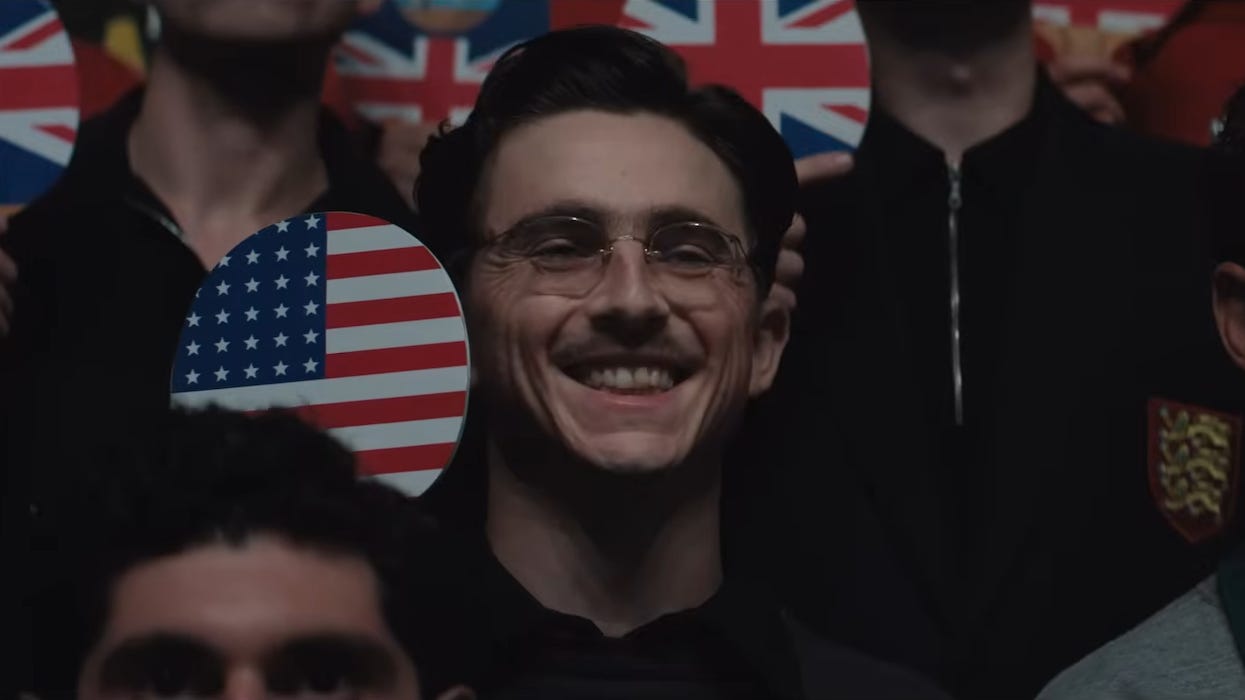
Marty Supreme follows a charismatic, delusional, annoyingly irresistable protagonist chasing an unhinged dream. IMO, this type of character study was done far more successfully this year in Darrow Farr’s The Bombshell (June 2025), with leading lady Séverine Guimard.
In both the 2025 novel The Bombshell and the 2025 film Marty Supreme, our young sexy protagonists want fame and glory and respect, but as it happens, life happens. Youth ends. They grow up. At the end of Marty Supreme, we don’t know what’s going to happen after his baby— “his new ping pong ball,” Dusty said— looks at him through the nursery glass like FOR REAL? THIS IS MY DAD? but we do know that Marty’s role as a Father, the built-in structure of the nuclear family, is going to dictate the next phase of his life.
It’s no surprise to me at all that the last monocultural moment of this year is a movie about a 20-something who, after he fails to make it to the top, is saved —or trapped, who’s to say?— by something greater than himself.
As 2026 rolls in enjoy the sweet relief that it’s not about you, or me, or any of us anymore. It’s way, way, way bigger than that, frighteningly so. HAPPY NEW YEARRRRR!!! ✪