
Blonde Affairs: Betty Draper
and a sugar detox

Welcome to Blonde Affairs—a new recurring dispatch from the AB Office of Emergency Management, where we briefly cover a single blonde (“blonde” defined here) whose recent moves have rendered them a matter of civic relevance.
From here on out, Blonde Affairs will hit your inbox on Saturday mornings TBD: still figuring it out!
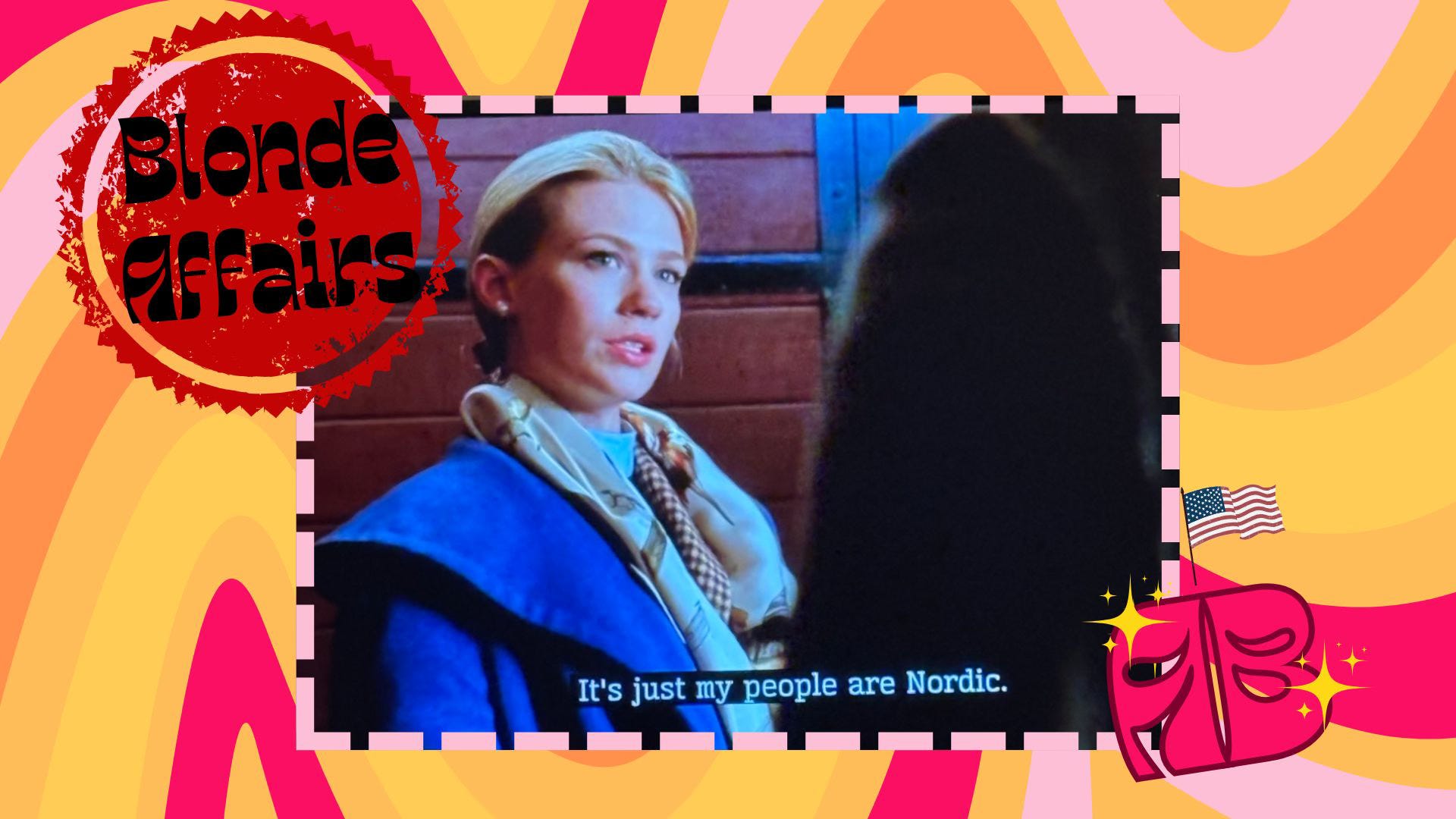
“You’re so profoundly sad.”
There used to be Thee Winter Show that would air once a week on television. Now, there is Thee Winter Binge Rewatch, society’s cope for collective dread. Just in time for this dark winter, HBO added Mad Men to streaming. Welcome back, Betty Draper!
Betty needs no introduction— she is an Annoying Blonde in the most classic sense.
Betty is 1960s Housewife Archetype. Betty keeps up appearances, and a tidy house. Betty is “Good” in the Christian sense of the word. Betty is also vain, childish, and dishonest with herself about reality, especially her own feelings. She spends the first two seasons of the show waiting to meet herself. She has one friend to her name; she is resentful of her husband, who doesn’t seem to ever want to fuck her, despite her striking resemblance to Grace Kelly, and her tiny waist. She is nostalgic for her late mother, even though her mother is painted as cold, critical, and misogynistic. Basically, we are meant to pity Betty Draper.
Most importantly, Betty is Freudian REPRESSION incarnate! Betty’s repression is era-specific. Her suburban storyline serves as a foil to the dramas unfolding at Sterling Cooper on Madison Avenue, where hedonism reigns, mirroring the psychology of advertising itself. (For those who haven’t committed the first twenty minutes of the The Century of Self to memory: the father of modern advertising, Edward Bernays, was Freud’s nephew).
“You’re painting a masterpiece. Make sure to hide the brush strokes,” is a quote of her mother’s that Betty Draper lives by. In other words, don’t mess up your perfect-looking life.
In the early seasons, the show presents Betty with various chances to “make a mess” and find out who she is outside her role as Don’s housewife: kissing Roger Sterling in her kitchen, say, or beginning an affair with Arthur Case, her crush from horseback riding class who is himself engaged to another beautiful blonde; or even responding to flirtations by Jimmy Barrett, the comedian who, when Betty doesn’t bite, retaliates by informing her of the affair her husband is having with his wife. Each of these moments offer Betty a “fork in the road,” let’s say, but her righteousness wins out every time. She’s not that kind of girl! Betty Draper doesn’t take the moral high ground, she sort of is the moral high ground. But because we know the 1960s were essentially a ten-year crescendo towards a new world order, her Goodness can be interpreted not as moral rectitude, but a defense against growth.
Meanwhile at Hedonism HQ, transgressions of this kind are constantly rewarded: see Don Draper’s brand new Cadillac, which he buys with his bonus after crashing his old car mid-rendezvous to the Hamptons with Jimmy Barrett’s wife.
Betty Draper has nothing to do in that Westchester suburb of hers. It seems like in the 1960s Ossining, NY has no canasta… no book club… no knitting club… just Smoke Cigarette with Pregnant Friend on Kitchen Stools, That Don’t Have Backs to Them. How uncomfortable! Betty cannot have fun, she doesn’t know how to, she has no framework for it. She is suffering behind her righteousness, yet January Jones plays her with such extraordinary empathy.
As the series goes on and Betty’s character becomes more of a distant antagonist, I find myself missing her. Jones illuminates the nuance of her unhappy marriage, all the colorful shades of it, with insane precision and pathos. It’s a GOAT-ed performance, IMO.
Betty is a model when Don Draper meets her, and she becomes a model of a housewife after marriage. Her conventional beauty, and her careful finishing, makes it easy to imagine the fantasy of the glamorous life she could have had, but isn’t having. Compare her to another quintessential Annoying Blonde of prestige TV, Carrie Bradshaw, and you see the difference between a woman whose yearning makes her the endearingly unhinged author of her own life, and a woman whose yearning is rendered pathological, the explanation for her tragic end.
For ten days in early January I was on a sugar detox— Betty Draper would call it a diet, though it was not—
—meaning I deprived myself of sugar and carbs for the first time in my life since I was ana-curious in 7th grade. (Adolescence, I don’t miss it!) I love chocolate, and I love bread, but somehow, we made it through. The detox helped regulate my mood. I ate more protein, so I had more energy. It made me feel like I could do anything— shout out to my Sugar Detox Cheer Club chat! Then it was over, and for the next few days I let myself have whatever I wanted. But my takeaway from the experience is that I found both the act of resisting, and the act of indulging, equally pleasurable. I wish someone could have told Betty Draper this…or Carrie Bradshaw, for that matter…
One of my favorite shots in all of Madmen is Betty riding fast on horseback, soon after receiving confirmation that Don has indeed been unfaithful to her. The couple will reconcile temporarily, her third pregnancy serving as a temporary band-aid on her sense of self, before all hell breaks loose.
Betty never again seems as alive to me as she does barreling down the racetrack on that beautiful horse, eyes squinted as if she is forcing herself to look directly at her future. You hope that revelation or freedom will come to her in this moment, but for now she is just a stay-at-home mom at her riding class, letting off steam.
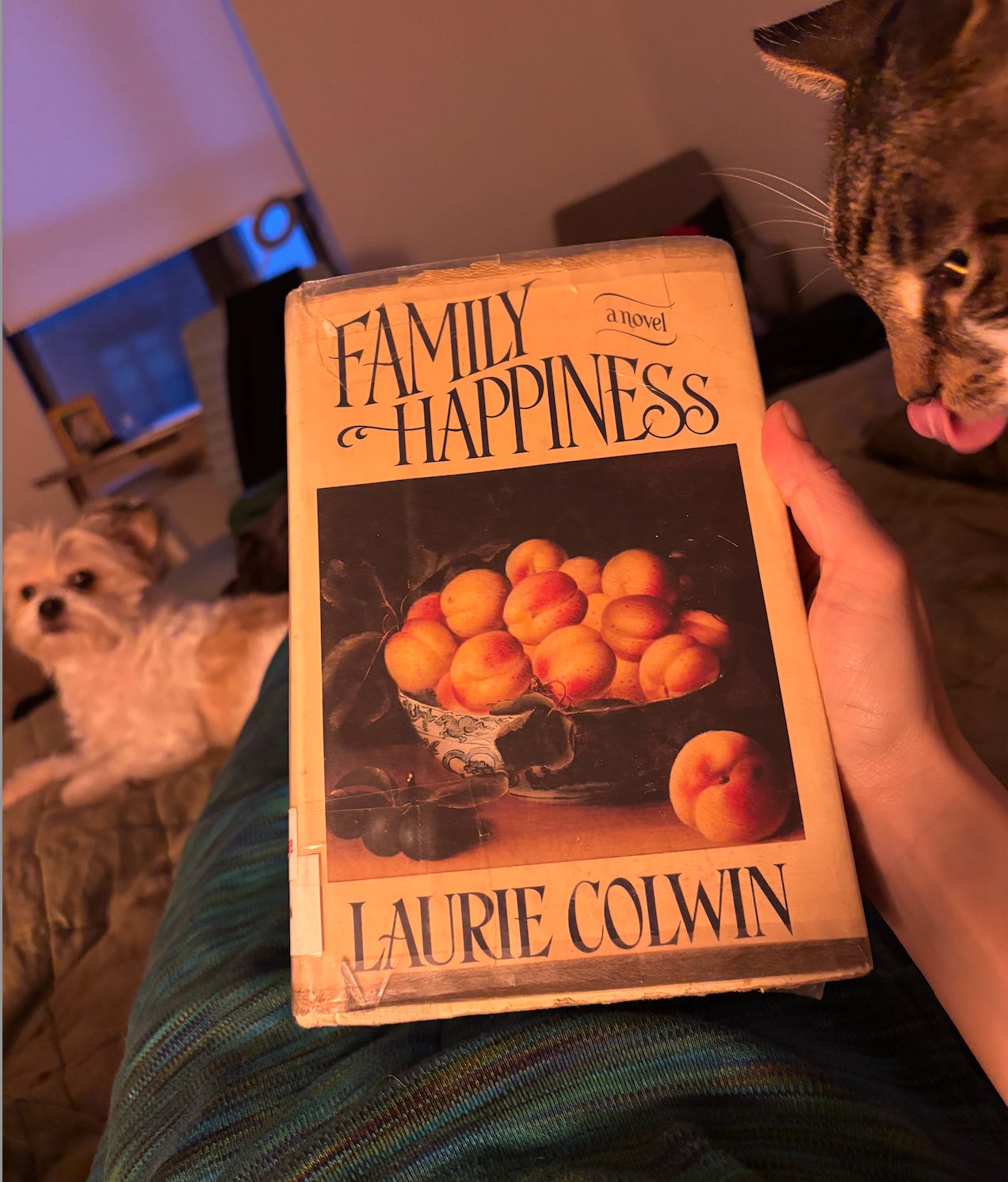
Book recommendation related to the life of a housewife: Family Happiness by Laurie Colwin. THANK YOU, Darri, for the recc!
Very curious to hear who else is rewatching Madmen this winter, and what your takeaways on Betty (or Joan or Peggy or Don or Roger) are this time around… ✪
I see shades of Don in every character, I felt that way the first time but the rewatch is making me realize why he had to let go of Dick and become this stoic, eloquent vessel for every character to emulate, impersonate, or admire.
betty draper is the protagonist of the show